

Why do some C-Suite Leaders take ownership of their failures, and others make excuses?
The Importance of High Internal Locus of Control
C-Suite mis-hires still average between 50% & 60%, costing millions in lost earnings and growth opportunities. Locus of Control is the assessment measurement the Center for Executive Performance uses to improve successful hire rates into the 90% or better.
The term locus of control was developed by psychologist Julian Rotter in 1966 to describe one’s general expectancy regarding why events in one’s life occur. People with a high external locus of control believe that life outcomes are driven primarily by external forces and attribute positive outcomes to luck, policies, the economy, or other factors. When things go wrong, they are more likely to blame others when outcomes do not align with expectations.
In contrast, people with a high internal locus of control believe that life outcomes are driven primarily by their own actions and that positive outcomes result from their choices, efforts, and learning. A high internal locus of control can be a significant asset for leaders, particularly during periods of high stress and ambiguity.
Locus of Control in Action: Two CEOs, Two Different Mindsets
Satya Nadella, the CEO of Microsoft, is a well-known leader who has repeatedly demonstrated a high internal locus of control. When he took over the company in 2014, he transformed the internal culture, attributing the company’s challenges to a failure of leadership rather than external forces. Up until that point, Microsoft employees had a “know-it-all” mindset, which was detrimental to the company’s growth and development. He took ownership of changing the organization’s dogma and created an accountability culture that rewarded learning and tied both successes and failures to leadership behaviors.
In contrast, Travis Kalanick, former CEO of Uber, demonstrated a leadership style characterized by a high external locus of control. When the company was in crisis, he often blamed external forces such as regulators, critics, or competitors rather than taking ownership of the situation at hand. He repeatedly looked outward for excuses for why things were not going as planned, rather than confronting his own leadership failures. His lack of ownership undermined trust and ultimately led to his resignation at the board’s request. Together, these examples highlight how one’s locus of control shapes leadership behavior and organizational health.
The Science Behind Internal Locus of Control
Research shows that an internal locus of control is correlated with higher motivation (Ng, Sorensen, & Eby, 2006), more proactive behavior (Spector, 1982), greater persistence (Shin, 2011), and higher job satisfaction (Judge & Bono, 2001). These characteristics improve decision quality, adaptability, and execution by increasing leaders’ awareness of how their actions drive outcomes. Leaders with a high internal locus of control also tend to have high self-efficacy, the belief that they can achieve their goals.
Furthermore, individuals with a higher internal locus of control tend to manage stress more effectively because they believe their actions can make a difference (Simpson et al., 2025). When stressful situations arise at home or at work, they have developed coping mechanisms to effect change, stay positive, and ultimately make decisions that improve their situation. These capabilities are especially critical for CEOs, who often operate in environments marked by ambiguity, public scrutiny, and high-consequence decisions.
Applying Locus of Control to CEO Selection and Leadership Assessment
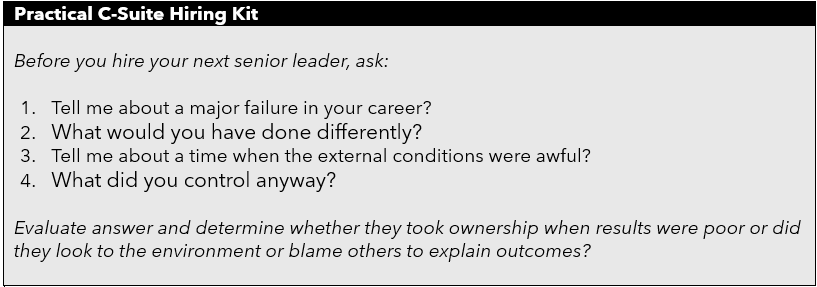
At the Center for Executive Performance, we routinely use locus of control along with other validated measures to inform our hiring, assessment, and development processes. We believe that people with a high internal locus of control are more likely to take ownership of their behavior and outcomes, both good and bad. When things go wrong, people with a high internal locus of control look inward for answers rather than becoming victims.
Having a leader with a low internal locus of control can be detrimental to organizational health. Work unit climate is often toxic due to a lack of accountability and weak learning cultures. Top performers leave because there is little correlation between action and results – their efforts frequently go unnoticed or are chalked up to luck or good timing. Teams led by leaders with low internal locus of control often experience low team morale and feelings of helplessness. The organizational culture frequently feels political because decisions are not based on merit or effort, but on external factors beyond employees’ control. Ultimately, having a low internal locus of control at the leadership level can undermine trust, engagement, and performance across the organization.
Top 5 Tips for Improving Internal Locus of Control
- Reliably own outcomes, track commitments, and correct quickly.
- Seek feedback and adjust behavior accordingly. Do not be defensive.
- Engage in daily or weekly reflection to enhance introspection. When outcomes do not go as planned, consider your own contributions to the outcome.
- Focus on the factors you can control within the organization, such as talent, decision-making speed, capital allocation, and customer perceptions. Do not worry about factors outside your control, such as competitors’ actions, regulations, or the political climate.
- Institute an accountability culture in your organization. Conduct After Action Reviews (AARs) that focus on improving processes, not assigning blame.
CEOs operate in highly stressful, highly ambiguous environments. A high internal locus of control is paramount for success among those in the upper echelons of leadership. The Center for Executive Performance offers assessment, coaching, and leadership selection support to help individuals and organizations build cultures rooted in accountability, ownership, and results. If you are looking to partner with leaders who take ownership, drive outcomes, and believe their actions truly matter, the Center for Executive Performance is ready to support you. Get in touch today.